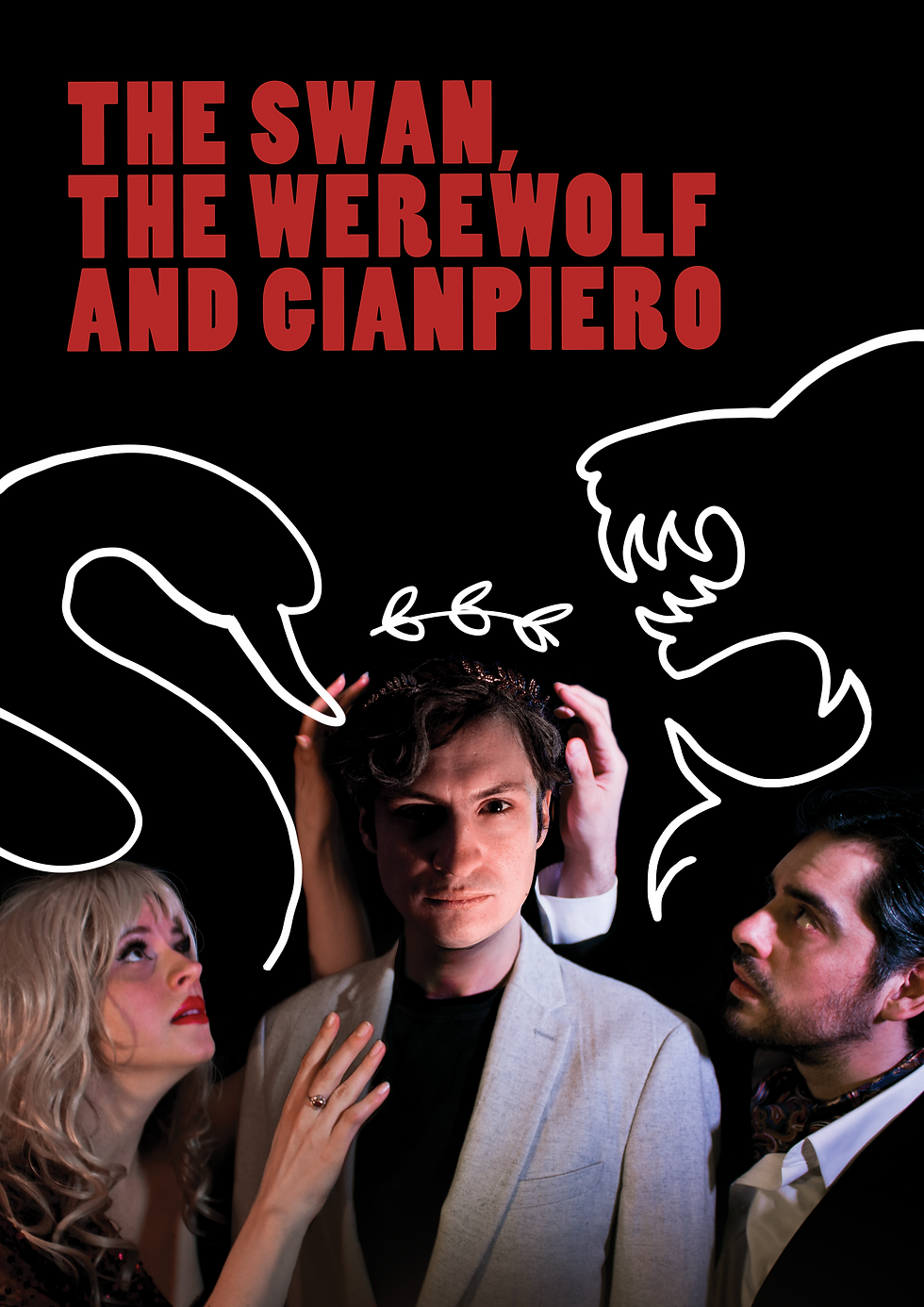
[Performance Analysis:] THE SWAN, THE WEREWOLF AND GIANPIERO, COLAB Tower, London.

Updated: Jul 28
This analysis has been written in the new Letters from a Mentor format introduced in July 2026. For more information on this format, visit this publication.
Dear Agata,
Your company’s idea to combine your performers’ interest in tango with your own experience in and pursuit of theatre work is a wonderful concept. Dance — and particularly tango, being so passionate and potentially violent in its rigidity and angularity — is an excellent foundation for the plot you have chosen, which demands tension, animosity, desire and ferocity.
However, there are a few major concerns I have with this performance which compromise its integrity and efficacy, and the first of these is clarity. It is clear you intend to conceive an intricate plot with multiple twists and turns and in a melodramatic style most synonymous with tango. However, the result of this is a much too complex narrative presenting a wide range of developments and events that together seem incoherent and excessive. The effect is convolution and hence dilution: it is easy to become lost with the plot developments, and this dampens emotional engagement, intrigue and thus investment. In hearing others divulge their thoughts, it was apparent to me that this was a general sentiment across audience members. We have a play within a play, dance sequences (which suffer themselves from this convolution–dilution, upon which I am happy to elaborate), concealed identity, misidentity, fantastical creatures (werewolves) and far-out characters (billionaire), and all of this is topped with a melodramatic style and ludicrous plot developments — there is a lot to wade through and in a period of time so short that none of these can truly be sufficiently explored.
The uniquely most explored element of your play is the titular character of the rich playwright Gianpiero (James Wilkinson). This character is the most established and the clearest simply because his intentions are plainly laid out. He is identifiable in his pomposity and egoism. He is the rich boy who has always gotten his way and has always been in the limelight. He is instantly recognisable, and this was particularly stand-out and useful in a performance with such chaotic content. While it is not entirely elucidated what Gianpiero’s play is and how it functions, both as an artistic work and as a “real-world” vehicle of marriage, it is clear that this self-righteous and entitled playwright wants notoriety in making successful and renowned theatre works and will tread over anyone in order to get it. One reason his presence as a character is so successful, not due only to Wilkinson’s excellent characterisation, is because we have present the correct formula for setting up tension: an antagonist’s goal. However, the lack of clarity as to of whom or of what exactly Gianpiero is an antagonist takes the steam out of this tension and compromises its payoff.

It is clear that tension is an intended significant focus for your work here — from the very beginning, we are launched into a conflict between the characters, wherein your character, Roxana, is late for her own performance, prompting a quarrel between her and Mateo (Esteban Mereles), who clearly have some history together. However, what this history is is not explicated, which is an important omission for a play like this: the audience needs to know why they care that the characters are not functioning together; there should be a definitive, emotion-driven reason to stay invested. Why is Roxana so sceptical of Mateo’s potential love affair? Where does that jealousy come from? Is it from their relationship history itself or from projected personal traumas? This lack of reason is a significant recurrent issue in this performance, and it compromises the efficacy of later plot developments: for example, while we can clearly see this is a dysfunctional relationship, it is more difficult, nay impossible, to understand why Roxana should be so maddened by Mateo’s existence that she should be driven to threaten to, and succeed to, shoot him.
Intention is the touchstone of tension: once we know that two characters have opposing intentions, we become extra alert as audience members about how this will play out. I would love to offer you more guidance on how circumstances, setting and consequence can allow this tension to culminate in a plot development that feels relevant, earned and complete — and furthermore on how tango is currently being used in your performance versus how it could be used as decisive choreography to extract, spotlight, intensify and progress character intention/motivation and plot.
I welcome you for further guidance on any or all of the following, which I have categorised into priority levels to pinpoint aspects I feel are most critical for us to work on together:
Ensuring tango is incorporated accurately and as a progressor of character relationships and plot. (High priority)
Reconsidering offstage conduct: eliminate distractions from off stage which compromise illusion. (Medium priority)
Ascertaining clarity in complex plots: character arcs, and narrative and act structures. (High priority)
Stylising characterisation: organic delivery for heightened and melodramatic character profiles. (Low priority)
Developing engaging character profiles with depth: considering motivation, intention, values, and objectives. (High priority)
Considering audience function: interactions with audience members. (Medium priority)
Conceiving relevant interstitial scenes. (Low priority)
Or if you have any questions or sparked ideas from this feedback, I would love to hear from you with these.
For My Readers
Are you working on your own performance and wanting to receive bespoke, detailed guidance and feedback? If you feel a written performance analysis, — or a live consultation or workshop — would benefit you, I welcome you to reach out to me to book your own!
You can easily reach me through whichever channel is most convenient for you:
DM me at @mytheatrementor on Instagram, on X, or on Facebook.
Send me a WhatsApp Business message: +447364 189 667
Email me: contact@leejamesbroadwood.com
Via my website's Chat Function: Use the 'Contact Me' button on the bottom-right of your screen.
Find out more about my mentorship service here.
![[Performance Analysis:] FEAR EATS LIFE, The Cockpit, London.](https://static.wixstatic.com/media/3a92ff_8cb8c5f00bc8491ea462322746ec2c57~mv2.jpg/v1/fill/w_980,h_1386,al_c,q_85,usm_0.66_1.00_0.01,enc_avif,quality_auto/3a92ff_8cb8c5f00bc8491ea462322746ec2c57~mv2.jpg)
Comments